Standing up for public education

Universal access to publicly-funded healthcare is a source of national pride and a social policy that Canadians are willing to go to great lengths to defend.  But are we equally prepared to stand up for our public education system? Recent events in Alberta put that question to the test. Last month, Danielle Smith’s UCP government invoked the Charter’s notwithstanding clause to order teachers back to work and impose on them a contract rejected by nearly 90% of Alberta teachers.

The Back to School Act is a direct assault on our fundamental rights and on the foundations of our democracy. The UCP hijacked the democratic process and forced the legislation through without any real debate. This kind of authoritarian behaviour is uncannily similar to how politics are currently being done in the United States

Alberta’s Back to School Act violates teachers’ rights to freedom of association and expression and jeopardizes the rights of all workers to collective bargaining. The UCP champions “freedom” when it suits their political narrative but strips it away from Alberta’s teachers without hesitation. An attack on teachers’ constitutional rights is an attack on the rights of every Albertan.

Alberta is a rich province, but we operate on a model of scarcity both in healthcare and in education. Over the past several years, provincial funding for schools has not kept pace with inflation or population growth. The results are poor learning environments for our children due to crowded classrooms, not enough teachers and inadequate infrastructure.

“Education is the great equalizer, reducing income inequities and breaking the cycle of poverty for the most disadvantaged.”

Alberta has the lowest funding rate for public school students among the provinces, yet subsidizes private schools with the highest funding rate – 70% of the amount for public school students. Increases in funding for private schools has outstripped increases to public school budgets, leading to tax dollars being diverted at the expense of public education. Ontario, by contrast, provides no public funding to private schools.

A single well-funded public system will do far more to support all children in Alberta, and families would not be forced to turn away from their neighbourhood school to seek out different learning environments for their children. Education like health is a public good.  Free market theory with its emphasis on choice and competition cannot be applied to education any more than it can be to health.  Providing public funding for charter and private schools to compete with public schools only undermines the efficiencies of a single high-performing system.

Public schools are an effective means of delivering education.  Research from the United States shows that public schools outperform private schools when adjusted for socioeconomic status.  Finland has the highest-ranking education system in the world and all schools in the country are publicly funded. Finnish schools are encouraged to co-operate and innovate together rather than compete with one another, leading to world class results.

Public schools recognize every child’s right to education and welcome every child.   By accepting and valuing children from all backgrounds, public schools embrace and celebrate diversity.  Students are best prepared for the real world by public school because we live in a world where businesses thrive on employee diversity, and where complex political and social problems are solved by considering diverse perspectives in decision-making.

Public schools are a powerful way to reduce avoidable and unfair inequities in society.  Being free and accessible to all, public schools reach and benefit everyone regardless of race, religion or socioeconomic status.  Education is the great equalizer, reducing income inequities and breaking the cycle of poverty for the most disadvantaged.  Decreasing inequity benefits rich and poor alike:  more equal societies have less mental illness, fewer crimes, less substance use and more trust among strangers. 

Albertans can act to defend this essential public institution. A Calgary teacher has applied to Elections Alberta to launch the Alberta Funds Public Schools petition, which needs 177,732 signatures by February 11, 2026, to trigger a referendum on ending public funding for private schools.

Teachers are standing up—for children, for fairness, and for the future of public education. We should stand with them. Albertans need to act: sign petitions and contact their MLAs to vigorously defend our public institutions and our democratic rights. Our government must hear clearly that we value every child’s right to quality public education and every person’s freedom and constitutional rights.

If we do not act now, we risk losing the very foundations of the Albertan way of life.

By Vamini Selvanandan© 2025. This work is licensed under a Creative Commons CC BY 4.0 license. Photo credit:Kampus Production on Pexels.com

Choose wisely in municipal elections

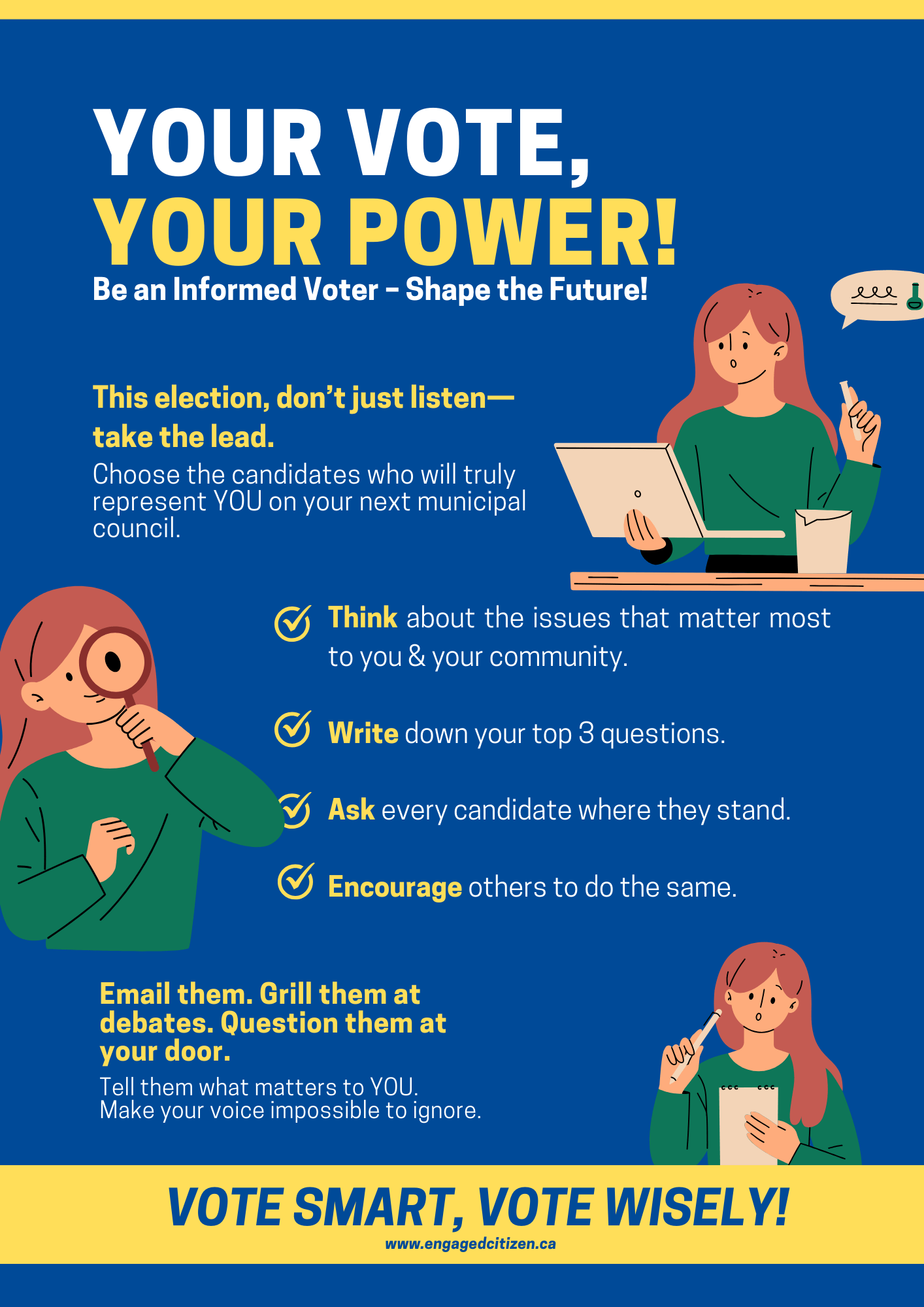
Municipal elections are upon us, and with them comes another opportunity to exercise our democratic right to vote. Elections remind us that we live in a society governed by the people. This is not something we can afford to take for granted. Having the power to choose leaders who will represent our communities—and holding them accountable for their decisions—is both a privilege and a responsibility.

Of the three levels of government in Canada, the municipal level is the closest to our daily lives. Municipalities are responsible for many essential services: clean drinking water, garbage collection, public transit, libraries, recreation facilities, and fire response. They maintain the roads we drive on, the parks where our kids play, and the arenas where our communities gather. These are the services that shape the texture of daily life.

Municipal leaders are also the most accessible politicians we have. They live in the same neighbourhoods, shop at the same grocery stores, and send their children to the same schools. They know our communities intimately. Perhaps that is why national polling consistently shows that Canadians trust their municipal governments more than provincial or federal governments to improve quality of life in their communities.

But here is a peculiarity of Canadian politics: incumbents almost always win. Across the country, candidates seeking re-election at the municipal level are successful 80 to 90 percent of the time. Sometimes this reflects genuine satisfaction with past performance, but often it’s a product of name recognition or the assumption that if someone already holds office, they must be doing something right. In smaller towns, incumbents sometimes don’t face any challengers at all and are simply acclaimed to another term.

This pattern is troubling. A healthy democracy depends on competition of ideas, not automatic re-endorsement of the familiar. When incumbents are returned to office by default, we risk stifling new perspectives and fresh solutions.

That’s why it is so important for voters to put in the effort to get to know all the candidates. A strong field of contenders signals civic vitality, but a level playing field depends on voters looking beyond name recognition. Most municipalities now provide candidate lists online with biographies or links to campaign websites. Many candidates post their platforms online or distribute them in print. Debates and community forums provide a chance to compare visions directly.

“Be cautious of candidates who promise quick fixes that push problems into the future, or who offer easy answers without addressing root causes.”

As voters, we should use these tools. Don’t stop at skimming flyers. Read platforms carefully. Review incumbents’ voting records on issues that matter to you. Attend debates or watch recordings if you can’t be there in person. These events reveal how candidates think on their feet and whether they understand the issues in depth.

What should we be looking for? Leaders with the skills, background, and judgment to handle the complexities of municipal government. People who can think critically, listen well, and make decisions with long-term economic, environmental, and social sustainability in mind.

Equally important is knowing what to avoid. Be cautious of candidates who promise quick fixes that push problems into the future, or who offer easy answers without addressing root causes. Be wary of those who dodge tough questions, give vague promises, or pass the buck to other levels of government when municipal leadership is required. Data gathering and public consultations are key elements of solving complex problems, but watch out for candidates who use these strategies to avoid or delay addressing established problems.

Voters themselves have a role to play in raising the quality of local democracy. We can’t wait for candidates to tell us what matters—we can set the agenda by asking the right questions. What will they do to make housing more affordable? How will they prepare our communities for the impacts of climate change? What is their concrete plan for supporting progress, not just offering promises?

There are many ways to press for answers. Email candidates directly. Attend debates and ask pointed questions. Stop to engage when they knock on your door. Tell them what matters to you and make your voice impossible to ignore. When voters are engaged, candidates take notice, and our collective priorities shape the conversation.

Municipal elections may not get the same attention as provincial or federal campaigns, but their impact on our lives is profound. This is our chance to choose leaders who will shape the future of our neighbourhoods, our services, and our communities. It’s not enough to vote out of habit, or to simply reward incumbents for name recognition. We owe it to ourselves, and to our communities, to choose wisely.

This is your moment. Do more than cast a ballot—cast an informed one. Ask hard questions. Demand real answers. Hold candidates to account. Your voice, your vote, and your choices will determine the direction of your community for years to come. Democracy works best when we all take it seriously. Let’s not waste the chance to shape the future right where we live.

By Vamini Selvanandan© 2025. This work is licensed under a Creative Commons CC BY 4.0 license. Photo by Mikhail Nilov on Pexels.com

Politics vs Public Health

Alberta is in the midst of a measles outbreak — and you would hardly know it. Unlike during the COVID-19 pandemic, our provincial leaders are keeping quiet. We are not receiving regular updates from the Chief Medical Officer of Health, nor has the premier publicly endorsed the most effective way to stop this outbreak: vaccination.

Alberta has the highest per capita rate of measles in North America with 1857 cases confirmed as of September 6, 2025 and many more unreported. Our province has more cases of measles than reported in the entire United States, a statistic of which no Albertan should be proud.

Measles is a highly contagious disease with serious complications such as pneumonia, brain inflammation and even death. Pregnant women, young children and those who are immunocompromised are most at risk. The measles vaccine is safe and extremely effective, with one dose of the vaccine providing 90% protection and two doses almost 100%.

But we have grown complacent about measles. In 1998, the disease was considered eliminated from Canada due to the spectacular success of immunization. Vaccines provide direct protection to those who are vaccinated and indirect protection to those too sick or young to receive the vaccine. But now the rate of vaccination in Alberta has plummeted to 72%, far below the 95% needed for herd immunity.

Disruptions to childhood immunization programs during the pandemic have contributed to the low measles immunization rates we are seeing today. But there is another important factor lurking in the shadows: post-pandemic politics. 

The political fallout from pandemic measures left scars within the United Conservative Party. Jason Kenney was forced to step down after plummeting approval from his own base, in part because of anger over COVID-19 restrictions. His successor, Danielle Smith, drew her lesson quickly: avoid strong public health measures, however necessary, if they risk alienating supporters. Within weeks of taking office, she fired Dr. Deena Hinshaw, the public health official who had competently led Alberta through the COVID-19 pandemic.

“Conservatism and public health are not inherently at odds. Protecting people from preventable disease should be common ground for all parties.”

The pattern has repeated itself. When measles cases first surfaced this spring, Alberta’s then Chief Medical Officer of Health, Dr. Mark Joffe, was silent in the public realm. One can only suspect that he was prevented from mounting a robust public health response that would have decisively ended the outbreak.

Meanwhile, the people paying the highest price are rural Albertans. The South, North, and Central health zones have the highest measles rates, while Calgary and Edmonton are less affected. Ironically, it is the very communities most vital to the UCP’s political success that are suffering most from its lack of action.

In Alberta, as in the United States, public health is under attack by politicians and their organizers looking to create division and win votes. Healthcare professionals enjoy high levels of trust, while politicians find themselves at the other end of the spectrum. Whether it is firing the Chief Medical Officer of Health or dismantling the leadership of the Centre for Disease Control, the political strategy is the same: sow mistrust in public health officials and reduce their ability to influence and improve people’s health. 

During the COVID-19 pandemic, medical leaders had authority under provincial health acts to order school closures, restrict gatherings, and impose measures to save lives. When those measures became unpopular, Alberta’s government clawed back that power. Kenney’s government did so by violating the Public Health Act. Smith went further: Bill 6, the Public Health Amendment Act, 2023 explicitly handed final decision-making during health emergencies to cabinet, sidelining the Chief Medical Officer of Health entirely.

What Alberta needs instead is political courage. Leaders should be restoring trust in public health officials, not undermining them. They should be guiding Albertans toward proven measures that protect lives. In an era when health decisions are increasingly shaped by political identity and social affiliation, the responsibility of leaders — political, religious, and community — is to steer people toward choices that safeguard their health and the well-being of those around them.

It can be done. Premier Doug Ford in Ontario, no one’s idea of a radical progressive, has publicly endorsed vaccination as the way to end the measles outbreak. Conservatism and public health are not inherently at odds. Protecting people from preventable disease should be common ground for all parties.

Yet Alberta’s government is moving in the opposite direction. This year, COVID-19 vaccinations will not be covered for most Albertans. Reminiscent of the disastrous “Best Summer Ever” campaign, the UCP seems determined to run another natural experiment on its people by reducing protections that other provinces are maintaining. The likely outcome is obvious: more emergency room visits, more hospitalizations, more avoidable suffering.

Albertans deserve better. We elect politicians to make life safer and healthier, not to put us at risk. If our leaders will not act to protect us, then it falls to us — as voters, parents, and citizens — to hold them accountable.

By Vamini Selvanandan© 2025. This work is licensed under a Creative Commons CC BY 4.0 license. Photo credit: Turuncu Sakal on Pexels.com

Ordinary people can do extraordinary things

We live in a time of complex and wicked problems: climate change, economic inequality, violent conflict and human rights violation. These problems seem too large to tackle and much too difficult to solve. What can the ordinary person do but throw up their hands in despair or stick their head in the sand and try to tune out the bad news coming from every direction?

However, we don’t have to accept the way things are. We are not too small or insignificant to make change. Cultural anthropologist Margaret Mead declared: “Never doubt that a small group of thoughtful, committed citizens can change the world; indeed, it’s the only thing that ever has.” 

We all have values about what is important and beliefs about how the world should be. But impact in the real world requires more than good intentions, it requires action. Many of us want to make change, but don’t know how to get started. 

You may wonder how can one go about effecting positive change in the world? Often the first step is to be able to articulate what it is you most care about. This is usually something that angers or frustrates you or keeps you up at night. Is it the threat of wildfire and the fear you will lose your home? Or are you worried that your children will not be able to afford renting or owning a home when they become adults? 

The next step is getting together with other people who share the same concerns to build a team to tackle the issue together. Usually having face-to-face conversations and building relationships is the best way to start. It is more effective than sending out mass emails or social media calls and hoping people show up. You can look to make connections at organizations you already belong to: schools, workplaces, religious organizations or neighbourhood committees.  

G7 protestors from around the world will soon be converging to let world leaders know what they care about, and they will do it with hundreds or thousands of other kindred souls. But these protests usually make little change. The demands are usually vague and based on abstract principles. Protestors make passionate speeches to raise awareness about global warming or the threat of nuclear weapons; childhood poverty or looming pandemics. But after the event, nothing changes.

“Democracy means power is distributed among the people and not concentrated in the hands of the few. It means that people have power and responsibility to shape the future.”

To make real change, you need to define your issue more specifically and state it in terms of the change you want to see. The ultimate goal needs to be broken down into smaller actionable steps. For example, do you want your provincial government to double its investments in renewable energy? Do you want your municipality to ensure twenty percent of housing stock in your community is perpetually affordable (meaning 30% or less of household income)?

You have to be strategic in how you get your demands met. It is necessary to understand who makes decisions about the issue you have defined. Mapping out the power landscape and building relationships with the people who are decision-makers on your issue is key to having impact. Timing is also important in influencing decision-makers. Politicians tend to be most responsive in the period leading up to the next election and corporation annual general meetings are a good opportunity to hold a company’s board of directors and executives to account.

Democracy means power is distributed among the people and not concentrated in the hands of the few. It means that people have power and responsibility to shape the future. For democracy to work, it cannot be a spectator sport. We cannot simply sit back and watch politicians score points off each other, spurred on by a media that is more interested in sensationalism than substance.

We must realize that our obligation to participate as citizens does not end at the ballot box. Through participation and engagement between elections, we need to hold politicians we elect to account, and make sure they are working for us. 

If we are apathetic, mistrustful and disengaged, we leave ourselves vulnerable to exploitation by people looking to seize power to enrich themselves and their friends. We don’t have to feel that change is being done to us. Instead, we can get together and make change. We can challenge the status quo and influence decision-making no matter who is in power.

So, if you are worried, frustrated or angry about the way things are in the world; if you find yourself shouting at the television newscast or venting your exasperations on social media; or if you have ever thought that someone should do something about an issue, then, guess what, it is time to break out of your complacency and realize that that someone is you!

By Vamini Selvanandan© 2025. This work is licensed under a Creative Commons CC BY 4.0 license. Photo credit: Jeffrey Czum on Pexels.com

No health without mental health

Mental health needs are receiving more attention in recent years, but there still remain huge gaps in understanding and acceptance of mental health issues. Community members often suffer in silence due to stigma that prevents people from asking for help or discussing addictions, suicide and life trauma openly with their friends, colleagues or family members.

Distinguishing poor mental health from mental illness can sometimes be difficult but important, because treatment approaches differ greatly. True mental illness is relatively rare and requires specialized psychiatric treatment, and sometimes hospitalization. Poor mental health, on the other hand, is common and stems from life events such as loss of a job or relationship, stresses from food or housing insecurity or from loneliness and social isolation. 

We know, for example, that Canadians in the lowest income bracket are 3 to 4 times more likely than the highest income Canadians to be labelled as suffering from mental illness. Data from the United States indicates that vulnerable populations are medicated with psychoactive medications at higher rates than the rest of the population. Children in foster care, those involved with the criminal justice system and black and Hispanic boys are systemically administered antipsychotics or other drugs to control their behaviour. 

Worrying and feeling sad or uncomfortable are a normal part of the human condition and can be expected responses to life events. Grassroots and community-led offerings like the events are key in building resilience and promoting ways to increase and maintain good mental health. Sharing circles and communal activities such as singing, dancing or cooking with others are key to building social connection and supports.

“We must direct efforts at correcting the societal problems that put some people into situations that are toxic to their physical and mental health”

Some of what we label as mental illness is a response to very difficult or unfair life circumstances. Many Albertans suffer from food and housing insecurity. Those employed in low-wage jobs with little job security and few benefits suffer from significant financial and job-related stresses that lead to anxiety, depression, substance misuse or even suicide. New arrivals to the community don’t have natural support networks of family and friends in close proximity. 

Temporary foreign workers face added stresses related to immigration rules and closed work permits that take away their freedom to choose their employer or job. Some Albertans also face oppression or discrimination based on race, gender, sexual orientation, or Indigenous status.

But we must be careful not to characterize external problems such as poverty, housing insecurity, or racism as internal problems requiring medication or talk therapy to “fix” the individual. Instead, we must direct efforts at correcting the societal problems that put some people into situations that are toxic to their physical and mental health. 

Living wages, affordable housing, food security and social inclusion are system solutions that we need to advocate for and implement to provide a permanent boost to mental health for Albertans. We can also increase social connectedness among residents, ensuring that no-one, particularly the elderly or others living on their own, suffer from loneliness and isolation. Municipalities can design towns to bring people together, provide natural spaces for recreation and opportunities for safe and accessible physical activity. 

Harmful use of substances is a significant problem in communities in Alberta and alcohol is the most commonly used substance. In 2017, the economic costs of alcohol-related harm totaled $16 billion dollars in Canada. Governments bear direct costs within the health care and criminal justice systems, but indirect costs are largely borne by employers and family members. For most adults, alcohol poses a bigger risk to health than other drugs and many of the previously touted health benefits of moderate drinking have largely been disproven.

When liquor sales were privatized in Alberta in the 1990s, alcohol consumption increased in our province while consumption in the rest of the country was in decline. Privatization also led to more drunk driving charges in Alberta and to reduced government revenues. Excess capacity in the system created by privatization caused alcohol prices to increase and the government felt that it had to cut taxes on alcohol to bring liquor prices more in line with the rest of the country. Government costs for regulation and enforcement also went up. Effectively, taxpayers were subsidizing the private companies that were now tasked with selling alcohol in the province.

Alcohol is related to lost productivity, family violence and increased crime including homicide and sexual assault in our communities. Some of the most effective methods for reducing crime and other alcohol harms in municipalities is limiting alcohol licences and density of retail outlets and reducing the hours alcohol is served or sold. We have much work to do, and we will succeed if elected officials and community members work together to make our communities healthier.

By Vamini Selvanandan© 2025. This work is licensed under a Creative Commons CC BY 4.0 license. Photo credit: Pixabay on Pexels.com

We are stronger together

Death, politics and religion – three topics we are told to avoid at parties and the family dinner table. But in this age of polarization and uncivil public discourse, we might have to reconsider this stance. It is time to relearn how to have difficult conversations with kindness and mutual respect.

We can add racism to the list of uncomfortable topics. Before the murder of George Floyd, we did not speak about racism in everyday conversation, but his death and the protests that followed brought about a collective social awakening of the horrors of racism in North America and around the world.

Now that the intensity of the moment has passed, we are once again reluctant to engage with the topic. Maybe we think that racism is an American problem, not a Canadian one. Or maybe we think that if we don’t talk about it, it can’t be a reality in our society. 

But racism is real for Indigenous Canadians who live on average 9 years less than non-Indigenous Canadians, and a shocking 19 years less in Alberta.  Racism is real for black men in Canada, who are incarcerated at much higher rates than white men. And racism is real for the Muslim family killed in London, Ontario while out for a walk on a beautiful summer day.   

Racism is not always conscious, explicit or visible.  It is easy to recognize racial slurs, overt acts of discrimination or hate crimes but much more difficult to identify the invisible systems and structures in our society that perpetuate unfair treatment and oppression.

If racism is an iceberg, overt interpersonal racism is the small tip that is visible above the surface of the ocean. The greater bulk of systemic racism lies below the water unseen. And just as it is with an iceberg, it is the invisible part that causes the most harm. Systemic racism denies people of colour good jobs, decent housing, higher education, quality health care and fair treatment by the criminal justice system.

“And for greater impact, they can recruit qualified and capable racialized people to lead their organizations. “

Historic examples of racism enacted through government policies and legislation are numerous: the Indian Act, residential schools, the Chinese Head Tax, Japanese internment, Canada’s exclusion of Jewish survivors fleeing Nazism. But systemic racism is not a thing of the past. We still have many laws, policies and practices across all sectors – health, education, justice, politics and business – that oppress racialized people. 

Real change in the lives of racialized people won’t happen until we take specific steps to include everyone in our economy, our institutions and in governance. So, what are some actions we can take towards these goals?

We can call for reconciliation with Canada’s Indigenous people to move beyond words to real action and can ask all levels of governments to co-operate to provide high quality services to Indigenous people and communities – from clean water to culturally safe healthcare to quality educational opportunities. We can advocate for Indigenous people to have control over their own governance, resources and land.

Employers and businesses can hire racialized people for good jobs that pay a living wage, have good benefits and clear pathways for advancing their careers.  And for greater impact, they can recruit qualified and capable racialized people to lead their organizations. 

Health, education, social service and government organizations need to hire frontline workers who reflect the diverse identities of the people they serve. The leadership of such organizations must also reflect the make-up of our communities. And organizations need to have formal anti-racism policies that are implemented through budgeting, hiring and procurement practices that focus on equity.

Furthermore, all of us can leverage our personal networks, resources and spheres of influence to shift outcomes for racialized people. We can use our purchasing power in businesses owned by people of colour to buy products and services or invest our money. We can encourage racialized people to run for elected office, donate to and volunteer in their campaigns, and vote for them in elections. We can read books, buy art, and attend performances produced by people of colour and we can rent dwellings to racialized individuals, couples or families as they often have a hard time securing housing.

This is not about favouring one group over another, but about levelling the playing field and including those who have been left out for far too long. When people chant “Black lives matter!” they are saying black lives matter too. When people cry out “Every child matters!” they are saying Indigenous children also matter. We must recognize the humanity in all of us and acknowledge that we are stronger when we stand together.

By Vamini Selvanandan© 2025. This work is licensed under a Creative Commons CC BY 4.0 license. Photo credit: fauxels on Pexels.com

Albertans deserve better health care now

Over half a million Albertans don’t have a family doctor, stressed families are waiting for hours in the emergency room with sick children, and frail seniors are living in pain for months, or even years, awaiting much-needed surgery. We expect our government to be urgently working to address these pressing healthcare issues.

But what have Premier Smith and her government been doing for the health of Albertans? Since coming into power, they have hired and fired four different CEOs of Alberta Health Services, paying an estimated $2 million dollars in severance pay for them not to work.  The government has dismissed two Alberta Health Services boards of directors, including one appointed under Smith’s leadership. Her government has spent another $2 million on an embarrassing review of data from the COVID-19 pandemic response – a report that has been condemned by the Canadian Medical Association, the Alberta Medical Association and dozens of doctors whose leadership was instrumental in saving thousands of lives during the COVID-19 pandemic.

And most recently, Alberta’s auditor general, Doug Wylie, has announced that he will be reviewing procurement and contracting practices within Alberta Health Services and the health ministry. He is responding to allegations of government interference and potential conflict of interest in multimillion dollar deals to buy medications and personal protective equipment, and in awarding expensive private surgical contracts. These allegations have not been proven in court.

“At worst, they are interested in concentrating power in their own hands, and rewarding supporters and friends.”

While this flurry of newsworthy activity is going on, in the background more expensive structural changes are underway to dismantle Alberta’s healthcare system. Our unified healthcare system was the object of envy for other Canadian provinces such as Nova Scotia and Manitoba who are using our previous healthcare system as an example to reform their own. At the same time, our government is taking a high-functioning single health authority and replacing it with a bureaucratic and fragmented system that fixes none of the problems that everyday Albertans face. 

The two-year $85 million exercise in restructuring Alberta’s healthcare system is a severe underestimation of how much taxpayer money will be wasted, as well as a diversion of time and energy from providing Albertans with the care they need right now. Imagine how many hip surgeries could be done for the same price tag, how many family doctors trained, and how many nurses hired to keep rural emergency departments open for Albertans in their time of need?

At best, the government is out of touch with the health care needs of Albertans, and why they were voted into power. At worst, they are interested in concentrating power in their own hands, and rewarding supporters and friends. Taken separately, any one of these blunders can be seen as an ill-advised misstep, but when taken as a whole there emerges a pattern of authoritarianism and disregard for public interests. It should make us question why we elected this government into power? What do we need to do as citizens to redirect the attention of our government to matters that will make a positive difference in our lives?

For one, we should be shouting from the rooftops that the voting public will not tolerate wasteful political and bureaucratic exercises paid from public coffers. While we tend to associate the word “corruption” with rogue states on faraway continents, it is naïve to think that mismanagement of essential public services and waste of taxpayer money does not happen in our own province.

We need to contact our Member of the Legislative Assembly (MLA) and call for an independent public inquiry into how multimillion dollar medical contracts were awarded by Alberta Health Services and the health ministry. We have to demand that public dollars never be used for pseudoscientific reports producing harmful health misinformation about ineffective or dangerous treatment of serious conditions. Most importantly we need to be asking our government to increase recruitment and retention of healthcare workers, train more nurses and primary care providers, and boost the capacity of publicly-funded hospitals to provide high-quality and timely surgeries. 

Our politicians have been elected to improve healthcare access, quality and timeliness for Albertans and we need to remind them of their duty. We need to be courageous in asking for transparency in how public dollars are spent and we need to hold our elected officials accountable. It is time to send the message to our government that we see what they are doing and it is not what we elected them to do.

By Vamini Selvanandan© 2025. This work is licensed under a Creative Commons CC BY 4.0 license. Photo credit: Photo by Lara Jameson on Pexels.com

Choosing health over corporate profits

January is a month when many of us promise we will try harder to become or stay healthy. We make New Year’s resolutions to eat better and lose weight. But by March or April, many of us feel deflated for not having enough willpower to maintain our commitment towards healthier eating.

Over the past few decades, the consumption of unhealthy, ultra-processed foods has grown and rates of obesity have soared. Is this due to a collective decline in willpower or is there some other force at play thwarting our sincere attempts to eat better? 

This year, to be successful in our quest for health, we must resolve to understanding and addressing the root causes of diet-related illnesses like hypertension, diabetes, heart disease and some cancers. 

For most of human history, we lived in a world where food was scarce, and malnutrition and starvation were a constant threat. But now we live in a word with an abundance of food, and yet still suffer from diseases related to food consumption. 

“Agricultural subsidies and the use of industrial farming practices results in more food being produced than is needed.”

It is time to address the elephant in the room. Corporations and shareholder interests powerfully shape our foodscape. A few large multinational corporations dictate what we eat, how much we eat and even where we eat. 

The food industry engineers the taste of their products to appeal to our evolutionary preferences for salt, sugar and fat and invests in laboratories to create foods that are increasingly addictive and difficult to consume in small amounts. Fast-food restaurants proliferate in low-income neighbourhoods, where they know people have poor access to grocery stores, and have little time or money to prepare meals from fresh, healthy ingredients. 

Agricultural subsidies and the use of industrial farming practices results in more food being produced than is needed. For example, in the United States, approximately 4000 calories per person per day are produced when the average person only needs half this to meet daily energy needs. To maximize profits for shareholders, the food industry comes up with novel and enticing ways to increase calorie consumption. They ultra-process foods – adding chemicals and removing healthy nutrients – to “add value” and create higher profit margins on inexpensive food products like corn and soy.

Additionally, advertising of fast-foods and ultra processed food to children ensures that the food industry creates a taste for their products early in life and generates loyal lifelong consumers. Powerful lobbies and donations to political parties ensure that policymakers turn a blind eye to the health harms of many corporate practices.

Even corporations not related to the food industry frustrate our efforts at healthy living when they pay low-wages resulting in employees being unable to afford healthy foods like fresh fruits and vegetables, and by setting long or irregular work hours, so employees don’t have the time to shop and prepare healthy meals for themselves and their families.  What these corporations don’t realize is that they are reducing productivity by creating unhealthy, stressed employees at higher risk of illness or injury and lost time from work.

If we want our efforts to eat better or lose weight to pay off, we have to first recognize and then address these powerful corporate effects on our health. No country in the world has been able to reverse the trend in increasing obesity by focusing only on educating and encouraging individual behaviour change. These strategies can only work if the social and commercial environment in which we conduct our lives supports our efforts.

Governments need to regulate the food industry to protect their citizens, particularly children who are becoming increasingly obese through no fault of their own. Policymakers need to ban advertising of unhealthy foods to children. They need to tax sugar-sweetened beverages as several other countries in the world have done resulting in a corresponding decrease in consumption. Canadians desperately need healthy foods like fruits and vegetables to be subsidized so we can all afford them.

We have to remind our governments that we elected them to act in our best interests. It is the job of governments to protect people and empower them to live healthy and fulfilling lives. We need to ask all levels of government to do their job by standing up to corporations and reigning in their predatory practices. It will require courage, commitment and persistence on the part of lawmakers to take on corporations who will not give up their profits willingly. But governments cannot be idle while corporations ruin the health of Canadians. 

By Vamini Selvanandan© 2024. This work is licensed under a Creative Commons CC BY 4.0 license. Photo credit: Mirko Fabian on Pexels.com

Celebrating 5 years of building a better world together